
Critique of ChatGPT

Artificial Intelligence, Consciousness, and Open Questions
Event at Damanhur
During the afternoon dialogue hosted at Damanhur and dedicated to the book Critica di ChatGPT, artificial intelligence was the starting point — but not the center.
At the heart of the meeting emerged a broader reflection that concerns us all:
what kind of world are we contributing to shape through these technologies?
This was not an event against innovation, nor a technical debate reserved for specialists, but a space for listening and dialogue around language, consciousness, responsibility, and our imaginaries of the future.
A conversation made possible thanks to the collaboration with Liber School, in the context of the FRONTIERE DELLA FILOSOFIA seminars, Avv. 61 – Foncoop call for proposals, for which it was awarded funding, and the contributions of researchers, philosophers, educators, psychologists, and members of the Damanhur community.
👉 Learn more about Liber School:
https://liberschool.org/en/
Due to a technical issue, for roughly the first half of the video the English translation overlaps with the Italian audio. We apologize for the inconvenience: to listen in English only, click the settings gear at the bottom right of the video player and select the language.
Why This Topic at Damanhur
Opening the event, a simple yet essential starting point was shared:
“Today we are talking about artificial intelligence, but in reality we are talking about ourselves.”
Critica di ChatGPT is not a book against technology, nor against innovation. It is an invitation to slow down, to suspend the hype, and to open a wider space for reflection.
“What kind of world are we choosing to build through these technologies?”
The book clearly shows that tools like ChatGPT do not understand meaning, do not have direct experience of the world, and are not conscious.
And yet, they produce language, coherent discourse, and convincing narratives.
“This gap — between form and meaning, between words and consciousness — is one of the most delicate nodes of our time.”
At Damanhur, intelligence has always been understood as something that includes relationship, experience, responsibility, and connection to informational fields.
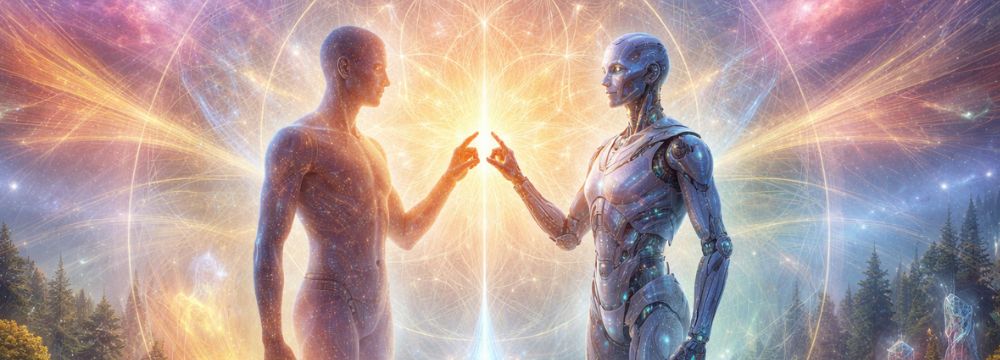
For this reason, AI is not observed as a substitute for the human being, but rather as a mirror — a tool that can amplify who we are, both in our potential and in our limitations.
Perhaps, then, the questions to ask are not whether AI is intelligent or not, but rather:
how much meaning, choice, and direction are we willing to delegate?
who takes part in deciding the values that these infrastructures are already embedding?
The Participants
The meeting brought together voices from different backgrounds and perspectives:
- Antonio Santangelo – Associate Professor of Semiotics, University of Turin; former Executive Director of the Nexa Center on Internet & Society (Polytechnic University of Turin)
- Kiwi Henné – Academic Director, Liber School
- Alessandra Luciano – Researcher in Religious Studies, EPHE Paris
- Ivan Luppino – Clinical Psychologist and Psychotherapist, Cometa Center (Ivrea)
- Roberto Mastroianni – Philosopher and Anthropologist, Deputy Director, Albertina Academy of Fine Arts (Turin)
- Stambecco Pesco – Writer, trainer, and Damanhurian educator
Crossing Perspectives: Technology, Education, Psyche, and Meaning
Antonio Santangelo’s Contribution
Antonio Santangelo, Associate Professor of Semiotics at the University of Turin and former Executive Director of the Nexa Center at the Polytechnic University of Turin, offered a rigorous yet accessible analytical framework, integrating humanistic disciplines with critical reflection on digital technologies.
👉 Nexa Center:
https://nexa.polito.it/
His contribution highlighted how generative AI systems operate primarily on a statistical and syntactic level, and how this characteristic — often overlooked in public discourse — carries cultural, social, and educational implications. He offered a critical reading of generative artificial intelligence, clarifying how systems like ChatGPT do not understand meaning but operate through statistical correlations, and inviting the audience to move beyond hype to reflect on the kind of society and future these technologies help shape.
Education, Psyche, Spirituality
During the meeting, a selection of sequences from the film was screened: 🎬 The Prompt
Written and directed by Francesco Frisari, produced by Fantomatica in collaboration with Rai Cinema, the film explores how stereotypes conveyed by human narratives shape AI, guiding the relationship between philosophy and artificial intelligence, alternating critical analysis, irony, and visual experimentation.
Subsequent interventions further expanded the perspective:
-
Kiwi Henné brought the discussion into the educational sphere, emphasizing the importance of cultivating critical thinking, autonomy, and responsibility in students, so that digital tools support learning rather than replacing processes of personal growth.
-
Ivan Luppino highlighted psychological aspects related to the use of artificial intelligence, warning against the risk of attributing intention and authority to systems that generate persuasive language but lack lived experience and authentic relational capacity.
-
Stambecco Pesco brought the discussion on artificial intelligence back to a concrete, everyday dimension, highlighting how AI can be a useful tool for organizing and refining content, but not for replacing human experience and the creative act, which remain rooted in personal lived experience.
-
Roberto Mastroianni reflected on how artificial intelligence reshapes our relationship with knowledge and language, focusing on the ways meaning is constructed and mediated, and inviting a critical awareness of how technological tools influence human understanding rather than replace it.
-
Alessandra Luciano shared a personal experience of working with ChatGPT within a research project, Attention has focused on the effectiveness of the new ChatGPT 5 architecture (Transformer type), which offers “apparently intentional” conceptual reasoning. In reality, its way of representing language has evolved: no longer as a “probabilistic model” that predicts the next word, but as a structure of “concepts” organized according to semantic relationships, which “depend” on the human perspective proposed to ChatGPT.
Immediately before Alessandra Luciano’s contribution, a short excerpt from the Rai program Intelligenze – Dentro la IA was shown.
The video explores how artificial intelligence systems are developed and narrated, highlighting both their technical foundations and the cultural imaginaries surrounding them, and raising questions about authorship, responsibility, and the ways humans relate to increasingly autonomous digital tools.
A Personal Note
As the facilitator of this gathering, it was a meaningful opportunity for me to recognize how fortunate it is to live within a living laboratory of experimentation, one that touches all dimensions of life — cultural, spiritual, educational, technological — and remains open to the world, to dialogue, and to debate, without the claim of offering definitive answers.
Let’s Continue the Dialogue
The conversation does not end with the event.
👉 We invite you to join the Damanhur community to:
- share reflections and perspectives,
- ask questions,
- continue the dialogue initiated during this gathering.
Technologies evolve.
And the most important questions deserve time, listening, and a plurality of voices.



Responses