
Frontiers Between Human and Artificial

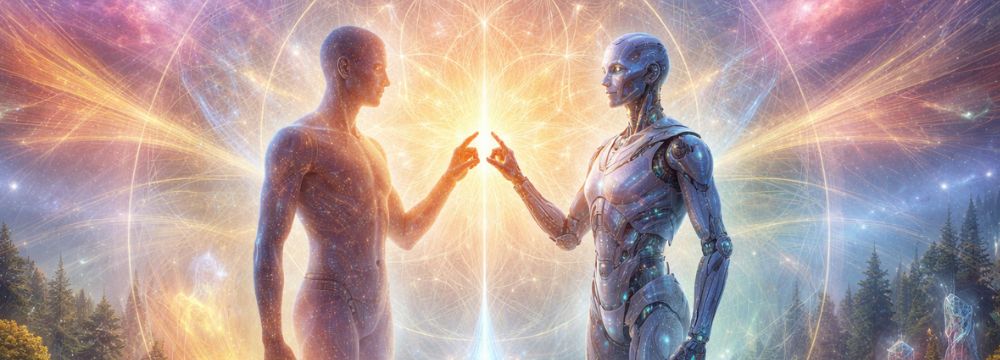
Reflections, perspectives, and open questions from a dialogue at Damanhur
👉 Watch the full conference video (in Italian). You can enable subtitles or automatic translation in the video settings if needed:
When we speak about artificial intelligence, there is a risk of becoming trapped in a purely technical, functional, performance-driven perspective. Yet every true innovation activates something much deeper: the way we think, perceive, create meaning, and build relationships.
It was in this spirit that Damanhur hosted the conference “Frontiers Between Human and Artificial”, bringing together philosophers, sociologists, educators, and researchers in an authentically plural dialogue. As often happens in the most fertile encounters, the outcome was not a set of definitive answers, but a constellation of questions, images, and intuitions worth cultivating.
As the facilitator of the event, I had the privilege of listening to very different perspectives that nevertheless resonated with one another in a surprisingly harmonious way — an experience deeply aligned with the vision of Damanhur and the legacy of Falco Tarassaco, where knowledge, lived experience, symbol, and inner transformation are never separated.
Thinking as Experience – Giovanni Leghissa
One of the most stimulating contributions came from Giovanni Leghissa, who challenged a purely computational view of the mind:
“Thinking is a practical act.”
“The mind does not calculate; it experiences.”
Thinking is thus understood as an embodied, situated, relational process. Leghissa also questioned several oppositions that often structure our way of interpreting reality:
“There is no origin, no inside and outside, no good and evil.”
This opens toward a non-linear conception of causality, where events resonate within dynamic networks rather than mechanical chains of cause and effect — a perspective that naturally echoes the notion of synchronicity.
Spirituality and Meaning – Luigi Berzano
Luigi Berzano explored spirituality as a rediscovery of inner life and as the capacity to attribute meaning to experience.
He emphasized that symbols should not be reduced to decorative elements, but understood as cultural tools through which people build orientation, belonging, and interpretation of reality. In a highly technologized society, this symbolic dimension requires conscious care if it is not to be impoverished.
This resonates strongly with Falco Tarassaco’s vision of the symbol as an operative instrument of consciousness.
Robots and Experience – Antonio Santangelo
Antonio Santangelo expanded the discussion on artificial intelligence by including robots as experiential components of AI.
When technology enters physical and relational spaces, it can no longer be seen only as computation. It becomes a phenomenon involving perception, interpretation, language, and imagination. What matters is not only what machines do, but how humans interpret and integrate them into meaning-making processes.
From the Individual to the “Condividuo” – Roberto Mastroianni
Roberto Mastroianni introduced the concept of the “condividuo,” moving beyond the idea of the isolated individual.
Human beings emerge as relational nodes within networks of language, technology, and culture. Knowledge becomes a shared, dynamic process rather than private accumulation — a view consistent with both digital transformation and community-based practices.
Educating Responsibility – Kiwi Henné
Kiwi Henné focused on education. In a world where many cognitive functions can be automated, education must cultivate presence, discernment, responsibility, and relational awareness rather than mere information transfer.
A Direct Experience with AI – Alessandra Luciano
Alessandra Luciano shared a direct experience of working with AI in a research project, raising questions about authorship, interpretation, intention, and responsibility. Her contribution grounded the discussion in lived practice rather than abstraction.
Body, Energy, and Relationship – Orango Riso
In closing, Orango Riso recalled the embodied and energetic dimensions of experience, emphasizing that intelligence cannot be separated from the living field in which it manifests.
Invitation to Watch
This article offers only a partial glimpse of the richness of the dialogue.
🎥 Watch the full conference video (in Italian). You can enable subtitles or automatic translation in the video settings if needed:



Responses